The Boundary Rope Does Not Mark Every Part of the Ground
Understand the cricket boundary rope and the ground beyond it, so you can read fielding space, nearby obstacles, and boundary decisions with confidence.
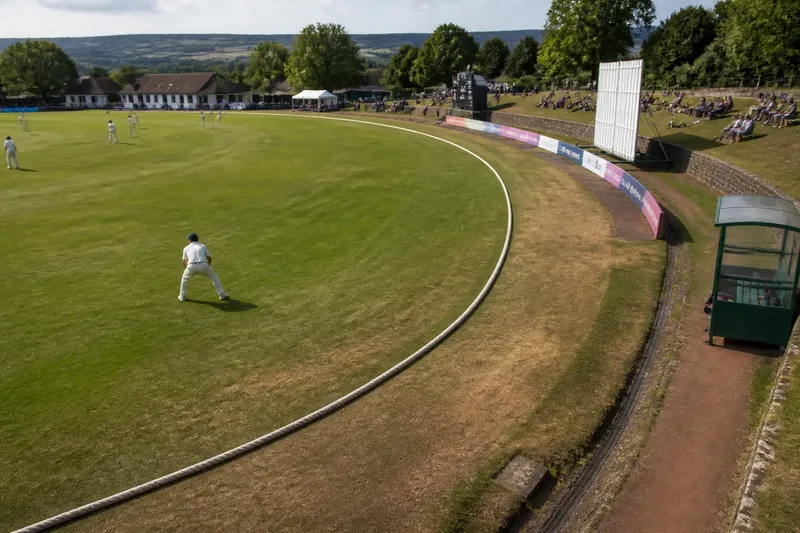
At a village ground, the boundary rope curves around a patch of worn grass while a sight screen, advertising boards, and a narrow strip of bare earth sit beyond it. The cricket boundary rope gives players and spectators a clear reference, but it does not describe every feature of the ground or turn the surrounding space into part of the playing area.
That distinction matters when you watch a fielder chase the ball, follow a boundary decision, or try to understand why two grounds with similar-looking ropes feel so different. The useful starting point is to treat the rope as a marker with a defined purpose, not as a map of everything that affects play.
What does the boundary rope actually tell you?
The rope marks the boundary line used to judge whether the ball has reached or crossed the edge of the field of play. Its path makes that line visible from a distance, especially where a painted mark would be difficult to see on grass. It can also help spectators understand where a boundary catch or ball in contact with the ground is being judged.
But the rope’s job is limited. It does not show the full shape of the outfield, identify every obstacle, or say what lies beyond the marked edge. A ground can have uneven grass, a shallow bank, a track, or a hard surface near the rope. Those features remain part of the setting even though the rope does not describe them.
Think of it as a visible edge for a particular decision, not a complete diagram. The playing area is the space in which the game is conducted; the boundary marker identifies a line used in relation to that space. Grounds and match arrangements can vary, so the rope should be read alongside the conditions in force for that fixture.
Why can the ground continue beyond the marked edge?
Many cricket grounds are shared spaces. A rope may be set inside a larger oval to leave room for spectators, benches, a running track, or equipment. At a purpose-built venue, the field edge may sit near advertising cushions and fixed structures. The visible ground therefore includes more than the marked playing boundary.
The area outside the rope is not automatically irrelevant. A fielder may run close to it, and a ball can travel beyond it. Nearby objects can also shape how the match is arranged. A sight screen, for example, sits where it helps a batter see the bowler, while a fence or dugout may limit how far a player can safely move. The rope does not explain those relationships; it simply provides the boundary reference.
Surface changes are easy to miss on television. Grass may give way to a paved path, a drainage strip, or another surface just beyond the marker. That transition can matter to a moving player and to how the ball behaves after it has left the field. Viewers should avoid assuming that the area outside the rope is uniform or empty.
How should you read a fielder near the rope?
Watch the player’s feet, hands, and the ball as separate things. A fielder can be outside the line while reaching back toward a ball, or can move across the marker while trying to stop it. The rope helps locate the boundary, but it does not by itself tell you what happened in a close play. The relevant question is how the ball and player related to the boundary under the match’s playing conditions.
For an invented example, say a fielder is running toward a low ball near a rope that curves around a corner. The fielder reaches down, the ball touches the grass, and the player’s momentum carries them across the marker. To interpret the play, follow the ball’s contact with the ground and the fielder’s position at the relevant moments; do not infer the decision from the player’s final position alone. The umpire applies the match conditions to those details.
A rope can also sit unevenly or shift slightly on a soft surface. That makes a camera angle or a spectator’s view less decisive than it may seem. Focus on the actual marker and the relevant contact rather than an imaginary straight line drawn from nearby boards or grass changes.
What nearby features can change the way a boundary looks?
- Curves and corners: A rope may follow a rounded edge rather than a straight arc. Look at the marker nearest the ball, not the broad outline of the playing ground.
- Advertising cushions: Cushions can sit beside or cover the rope. Their appearance may make the boundary seem thicker or farther out, so identify the marker itself where it is visible.
- Fences and banks: These can stand outside the marked edge or run close to it. They show the venue’s limits, not necessarily the playing boundary.
- Tracks and paths: A hard strip beyond the rope may interrupt the grass and affect a fielder’s footing. It remains a ground feature, not a substitute boundary marker.
- Drainage channels and bare patches: These can create a visible change in the surface near the edge. A change in color or texture does not automatically mark the line.
- Sight screens and equipment: Their placement helps the match function, but they do not define the field’s outer limit.
These details are useful because a ground’s visual edge and its marked boundary may not coincide. If you are watching in person, use the rope or boundary cushion as your reference. If you are watching a broadcast, pay attention to camera views that show the marker rather than relying on a wide shot that compresses distance.
What should you check before interpreting a boundary call?
Start with the match setting. The boundary may be marked by a rope, a fence, or another agreed feature, and the match conditions explain how the boundary is treated. The governing playing conditions and the venue’s instructions determine the applicable rule, so consult those rather than assuming that every ground uses an identical arrangement.
Then separate what you can see into three parts: the marker, the player or ball, and the surrounding ground. Ask whether the marker is clear in the view, where the ball made contact, and whether a fielder was involved at that moment. This keeps a close call from becoming a guess based on the nearest obstacle.
Also notice whether the rope follows a consistent curve. A ground can have different distances around its edge, and that variation is part of the venue’s layout. It does not mean the rope has stopped functioning as the boundary reference. The line can be irregular in shape while remaining clear in purpose.
How does this distinction help you read the ground?
Is everything beyond the rope out of play?
The marked boundary separates the field of play from the space beyond it, but the surrounding area can still matter to players and match arrangements. A fielder may have to move through a changing surface, while venue features can sit close to the line.
Does a fence always mark the cricket boundary?
No. A fence may surround the venue, stand behind the rope, or form part of the agreed boundary arrangement. Check the match’s local conditions and the visible marker instead of treating every fence as the line.
Why does the rope curve instead of making a neat circle?
The available ground, nearby structures, and venue layout can shape where the boundary is placed. The rope follows the boundary chosen for the match, so its contour may bend around practical constraints rather than form a regular shape.
Can the rope itself move?
A marker resting on grass can shift, especially in busy or soft areas. If its position appears unclear during a close decision, the officials use the match arrangements and available evidence rather than a viewer’s guess about where it began.
When you next watch cricket, look once beyond the rope before play begins. Notice the sight screen, the surface change, and any path or barrier near the edge. That small scan makes the boundary easier to read: the cricket boundary rope marks a reference line, while the rest of the ground remains a varied place that players must move through.