The Scorebook Before the Scoreboard
A cricket scorebook turns scattered match events into a usable record, helping scorers track each delivery and reconstruct how an innings unfolded.
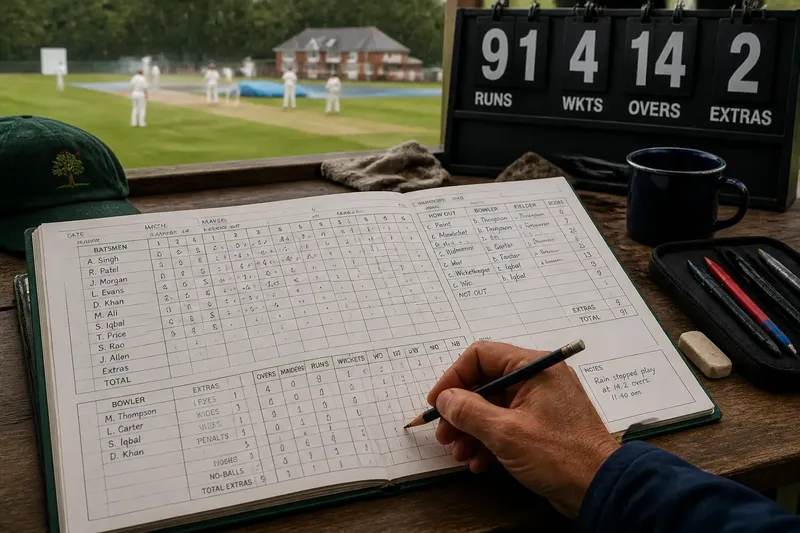
The scoreboard at a village ground shows a total, but the paper cricket scorebook beside the scorer’s chair explains how that total took shape. A pencil mark can preserve a batter’s runs, a bowler’s spell, a wicket and the delivery that ended an innings, all in a compact record. The scorebook’s columns make separate events easier to follow and the match easier to reconstruct after play.
Imagine an invented Saturday match at a small club ground. A sudden shower interrupts the second innings, the scoreboard operator misses a change of strike, and players later disagree about which bowler conceded a boundary. The scorer has kept a paper record ball by ball. This is not a real match or test; it is a hypothetical situation that shows what the book can preserve, how its layout supports accurate scoring and what a reader can learn from it.
What does the scorebook record that a total cannot?
A scoreboard compresses play into a few changing figures. A scorebook keeps the connections behind them. Each entry can show who faced a delivery, what happened, which bowler delivered it and whether the event changed the batter’s or team’s score.
That structure matters when a match pauses or a figure looks wrong. The scorer can work backward from the innings total to the entries that built it, rather than relying on memory. A scorebook also preserves events that do not add runs: a dot ball, a wicket, a wide or a no-ball can affect the account of an over even when the batter does not hit the ball.
Paper is useful not because it can never be mistaken, but because a well-kept page makes the path through an innings visible. An electronic display may update the audience’s view; a paper book gives the scorer room to preserve a working record, check a developing total and note a correction clearly.
How do the columns turn play into a record?
Scorebooks vary in design, but the familiar layout separates the batter’s innings from the bowling figures and team extras. Those are different views of the same deliveries. A run scored by a batter belongs in that batter’s record; a wide belongs among extras and is charged to the bowling side’s account, not entered as a batter’s run.
The central scoring area usually provides space for each over or delivery, with symbols that record outcomes compactly. A scorer may use a number for runs, a dot for a ball with no run, and a wicket notation for a dismissal. The exact symbols can vary, so readers should use the key printed in the book or agreed by the scorers rather than assume every club uses identical marks.
Other columns support the account. Batter names and dismissal details identify who was at the crease and how a wicket fell. Bowling figures collect overs, maidens, runs conceded and wickets. Extras are recorded separately, then added to the innings total. A neat page helps reveal whether a number has been placed in the wrong category.
Think of the layout as linked ledgers, not a single running total. One delivery can affect several parts of the page: the team total, a batter’s runs, a bowler’s conceded runs and the ball count. Keeping those effects distinct is what lets a scorer check the arithmetic without losing the story.
What happens in the invented interrupted innings?
In the hypothetical club match, the chasing side starts with two named batters. The scorer writes both names in the batting section, records the opening bowler and begins the first over. The first delivery is played without a run, so the book receives the agreed dot notation. A later stroke brings two runs; the scorer adds those to the batter’s line and the team’s total.
Next comes a wide. It adds an extra to the team score and is recorded in the extras account. Because it is not a legal delivery, it does not count as one of the over’s legal balls. The scorer records it according to the book’s conventions, keeping the extra separate from the batter’s runs. This distinction will matter when someone checks the over and bowling figures.
On a later delivery, the striker is caught. The scorer notes the dismissal, identifies the bowler and catcher where the book provides space, and records the new batter. The wicket does not erase any runs already made. The entry preserves both the change in the batting lineup and the event that caused it.
Near the end of the over, a boundary prompts confusion. The scoreboard operator sees the total rise, but cannot remember whether it came from a boundary or from running between the wickets. The paper entry shows the boundary notation in the delivery sequence. The scorers can compare that mark with the batter’s total and the bowler’s runs conceded, then correct the public display if needed.
Rain then stops play. The players leave the field before the innings ends, and the scoreboard remains at the last displayed total. The paper page still shows how many wickets have fallen, which batter was facing at the interruption, the completed overs and the events within the unfinished over. When play resumes, the scorers can re-establish the match state from the record rather than reconstructing it from recollection.
How can a scorer check the page as play continues?
A paper record works best when the scorer pauses briefly after each event and checks the connected entries. Avoid waiting until the end of an over to remember several balls at once. The pace of play can make a brief, consistent routine more dependable than a hurried catch-up.
- Confirm the striker. Check which batter faced the delivery before making the mark, especially after runs or a change of ends.
- Record the event first. Mark the delivery using the book’s notation, then enter its effect in the batter, bowling or extras columns.
- Keep extras distinct. Record wides, no-balls, byes and leg-byes in the appropriate category rather than assigning them automatically to the batter.
- Check the over count. Count legal deliveries, not every event that appears in the over. Use the scoring rules and book key for the match.
- Reconcile the totals. Compare the sum of batter runs and extras with the team total at a natural pause.
- Mark wickets clearly. Note the dismissed batter and the mode of dismissal so the batting order and wicket count remain understandable.
- Correct visibly. If an entry is wrong, make a clear correction that leaves the original mark readable where practical. Avoid changing a figure so heavily that later readers cannot follow the adjustment.
These checks are not a separate audit performed at the end. They fit into the scorer’s rhythm and make a developing error easier to spot while the sequence is still fresh.
What can a reader reconstruct from a scorebook?
Once play is over, the record can answer questions a final total cannot. A reader can follow when a partnership began and ended, see which batters contributed runs, and identify where extras added to the innings. Bowling figures help show how the bowling side’s work was distributed, while the sequence of entries can indicate whether scoring was steady or interrupted by quiet spells and wickets.
There are limits. A scorebook is a scoring record, not a complete account of every movement on the field. It may not explain why a batter chose a particular shot, how a fielder positioned themselves, or what the conditions felt like. Comments can add context, but the core record should remain legible and factual.
For the invented club match, the book does not settle every argument about the innings. It does establish that the boundary was recorded, show the extra from the wide, identify the dismissal and preserve the match state when rain stopped play. Those details help the scorers explain a correction and give players a shared account of what happened.
Which scorebook questions come up most often?
Why is an extra not credited to the batter?
Extras belong to the team’s score but are classified separately from batter runs. The distinction keeps the batter’s individual innings and the bowler’s figures consistent with the scoring rules.
Does a wide count as a ball in the over?
A wide is not a legal delivery, so it does not count toward the legal-ball count of the over. The scorer still records it and its effect on the team and bowling figures.
Can two scorers use different symbols?
Yes, scorebooks and local conventions may differ. Scorers should agree on a notation key before play or follow the one printed in the book, then apply it consistently.
What should happen if the book and scoreboard disagree?
Compare the delivery sequence and the linked totals in the book before changing the display. If the record itself is uncertain, the scorers should resolve the matter together under the match’s rules rather than guess.
Why does the page still matter beside a modern board?
The scoreboard serves people watching from a distance; the scorebook preserves the route to its figures. That route is especially useful at a small ground, where one person may be tracking the display while another records the innings, or where play can pause before anyone has time to discuss a disputed total.
For a reader searching for how a cricket scorebook works, the practical point is simple: follow each delivery across the relevant columns instead of treating the page as a collection of isolated numbers. A total is the result. The linked entries explain how it was reached.
Keep the book dry, use a pencil that writes clearly, and leave enough space for names and corrections. At the end of an innings, check that the total, wickets, extras and bowling figures tell a consistent account before putting the record away. That small habit gives the next reader a page they can understand without needing to have been there.